Saunas · 13 min read
Outdoor Sauna Buyer's Guide (2026): Cabins, Cubes, Installed Cost and Winter Use
Outdoor cabin, cube, glass-front and infrared saunas from Almost Heaven, Redwood Outdoors, Dundalk LeisureCraft, Thermory, SaunaLife, Auroom and Clearlight compared on price, heater, wiring and warranty, plus what the foundation, electrician, permits and winter really add.
By Ellis Ward, Founder & Editor ·
We may earn a commission from links on this page. Learn more.
Searches for outdoor saunas climb all autumn and peak in midwinter, which is also when you find out whether yours was a good idea. A backyard sauna is a small heated building: it needs a level base, a heavy electrical circuit or a chimney, a roof that sheds snow, and a plan for drying the wood after every session. This guide covers the shapes worth considering beyond the barrel, what the main brands ship and charge this fall, what the install really adds, and what owners report about winter. We have not built or tested these kits. Figures come from manufacturer pages and manuals, dealer listings, cost guides, municipal codes and owner reports, all linked at the bottom.
Barrel, cabin, cube, glass front or infrared?
- Barrel. The cheapest way to get real Finnish heat outdoors, and it can sit on pavers or decking. It has a single wall of wood and no insulation. Covered in depth in the barrel sauna buyer's guide.
- Cabin. A small square building with a pitched or flat roof and usually a glass door. It has more headroom and is easier to roof against snow, but Almost Heaven says cabins and cubes need a prepared foundation, "typically concrete".
- Cube. A cabin with a flat roof and a modern shape. Almost Heaven's Blackwater is the best-known one in the US.
- Glass front or view. A full glass wall facing the yard. It looks spectacular, but glass loses heat, so the heater has to be sized up for it.
- Outdoor infrared. Lower heat (no steam) from built-in panels and a far lighter electrical load. It is weather-resistant rather than weatherproof, so read the cover and shelter terms.
Outdoor cabins and cubes compared
| Model | Type, seats | Heater included? | Heater circuit | Price seen (10 Nov 2026) | Warranty |
|---|---|---|---|---|---|
| Redwood Outdoors Cabin 4-Person | Thermowood cabin, 4 | Yes, Harvia KIP 8 kW | 240V, 40 A breaker (dealer) | $6,099 at a dealer (list $7,599) | 1 year on the sauna |
| Dundalk LeisureCraft Georgian Cabin | Eastern white cedar cabin, 2–6 | No; 8–9 kW recommended | Depends on heater | $7,647 at dealers; $8,563 with porch | 5 years (one dealer) |
| Thermory Medium Square No. 42 | Thermo-spruce square with panoramic back window, 3–4 | No; packages from $12,728 with a HUUM Drop 9 | Depends on heater (Drop 9: 50 A) | $8,619 kit only | Not stated |
| Clearlight Sanctuary Outdoor 2 | Full-spectrum infrared, 2 | Yes, built-in infrared | 240V/15A, plug-in | $8,599 at a reseller | Heaters lifetime; cabinet 5 years |
| Almost Heaven Blackwater Cube | Cedar cube, 4–6 | Yes, 9 kW electric (wood stove option) | 240V, 45 A, hardwired | $9,859.50 sale (list $14,085) | Limited lifetime on the sauna |
| SaunaLife GL6 Garden Luxury | Thermo-spruce view cabin with porch, up to 6 | No; 9–10.6 kW options | Depends on heater | $12,790 plus $950 freight | Not confirmed for GL6 |
| Almost Heaven View | Nordic spruce cabin with floor-to-ceiling window, up to 4 | Electric or wood options | Depends on heater | $14,179.90 sale (list $20,257) | Limited lifetime on the sauna |
| Auroom Aura | Black thermo-spruce glass-front cabin, 2 | No; 4.5–6 kW recommended | 240V hardwired | $18,490 plus $1,250 freight | 2 years |
Read the heater column first. A $7,647 cabin with no heater can cost more than a $9,860 cube with one once you add an 8–9 kW heater ($1,258–$1,314 for a Harvia KIP80B; $3,133 for a HUUM Drop 9 package with controller and stones). The Redwood cabin is the cheapest complete package here, but its one-year warranty is short for the money.
The outdoor sauna we rate is a barrel: the 4-person Almost Heaven Pinnacle, $5,302.50 on sale with a 6 kW heater. If a barrel fits your yard and climate, it costs thousands less than anything above. Read the full Pinnacle review or compare it with indoor cabins on our best home saunas page.
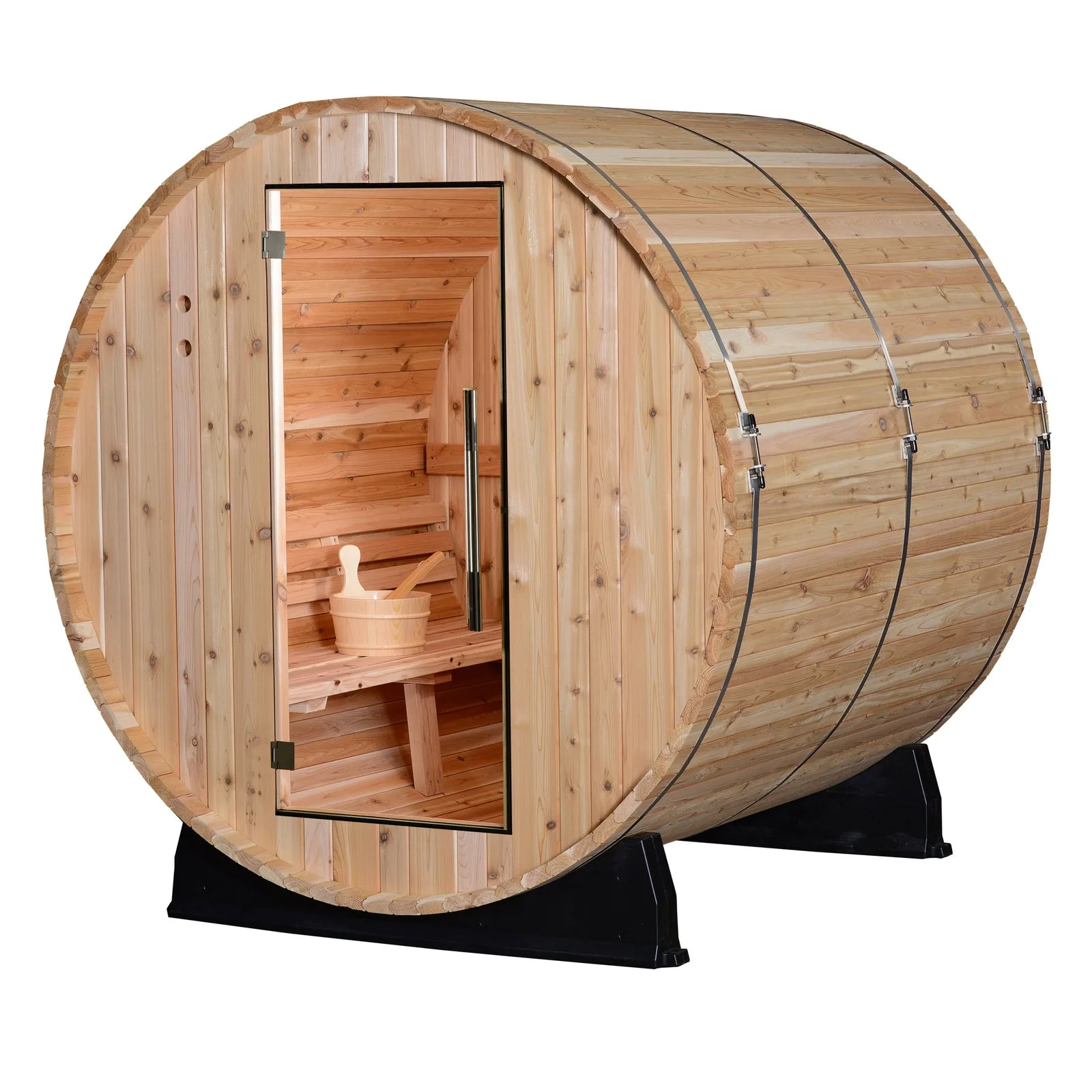
Almost Heaven
Pinnacle Barrel SaunaA backyard barrel sauna for people who want real Finnish heat and a reason to go outside in January.
What an outdoor sauna really costs, installed
| Item | Typical cost | Source |
|---|---|---|
| Gravel pad, professionally installed | $320–$800 for 8 × 10 ft; national average $1,400 | Angi, Oct 2026 |
| Concrete slab | $4–$8 per sq ft | This Old House, Mar 2026 |
| 240V power run to a backyard structure | $1,000–$3,800 typical, $2,500 average; trenching $5–$12 per foot | Angi, Oct 2026 |
| Short 240V circuit near the panel | $500–$800 | Fixr, 2025 |
| Kit freight | $599–$1,250 flat rate at dealers | Dealer listings, Nov 2026 |
| Professional assembly (Almost Heaven) | From $1,400 | Almost Heaven |
| Crane for a prebuilt sauna | $1,250–$3,600+, depending on access | A Washington builder |
| Stainless chimney kit for a wood stove | About $1,433 (Harvia M3 kit) | Dealer listing |
A worked example, using our arithmetic on the figures above: a Blackwater Cube at $9,859.50, an 8 × 10 gravel pad ($320–$800), a power run ($1,000–$3,800) and Almost Heaven's installation (from $1,400) come to about $12,600–$15,900 before shipping, permits and tax. The electrical run is the swing factor. Put the sauna 50 feet from the panel rather than 200, and you save thousands.
Foundation: what sits under it
Almost Heaven says barrels can sit on pavers, decking or firm, flat ground, but its cabins and cubes need a prepared foundation, with concrete usually best. Clearlight's dealers specify a raised, level concrete or wood base for the outdoor infrared cabin. Weight is the reason: the Redwood cabin weighs about 1,150 lb empty and the SaunaLife GL6 about 2,200 lb, before people and water. A compacted gravel pad is the cheapest base an installer will usually accept for a kit cabin; a slab costs more but stays level for longer. Keep the base a little larger than the footprint so rain drains away from the bottom boards.
Power: the 240V question
- Electric traditional heaters draw a lot. A Harvia KIP 8 kW draws 33.3 A (40 A breaker). A HUUM Drop 9 draws 37.5 A and calls for a 50 A breaker with 8 AWG wire. The Blackwater Cube's 9 kW heater needs a 45 A circuit.
- Infrared is far lighter. The Clearlight Sanctuary Outdoor 2 runs on 240V/15A with a plug-in cord, which can make the electrical work much cheaper.
- Distance drives the bill. Angi's figures run from $500–$1,250 for a 50-foot run to $2,000–$5,000 for 200 feet. Ask for a quote before you choose the spot.
- It needs a permit almost everywhere. All three municipal codes we read require an electrical permit for new circuits, even when the building itself is exempt.
- Running cost is the same as for any sauna. Try the sauna running cost calculator.
Electric or wood-burning heater?
| Heater | Type | Output | Needs | Price seen (10 Nov 2026) |
|---|---|---|---|---|
| Harvia KIP80B | Electric, dials on the heater | 8 kW | 240V, 33.3 A, 40 A breaker | $1,258–$1,314 |
| HUUM Drop 9 | Electric, app control (UKU) | 9 kW | 240V, 37.5 A, 50 A breaker | $3,133 package with controller and stones |
| Harvia M3 | Wood | 16.5 kW | No power; T600 chimney, non-combustible floor | $969–$1,077 (chimney extra) |
| Kuuma Classic | Wood, US-made | Sized for 336–1,000 cu ft | 6-inch Class A chimney | $2,395–$2,795, factory direct |
- Electric wins on convenience. You can start the HUUM from your phone on the way home, and the KIP has a delayed start of up to 8 hours. There's no firewood and no chimney.
- Wood wins in remote or very cold yards. It needs no 240V run, and the M3 is rated at about twice the output of the electric heaters above. One Minnesota owner took a small Kuuma-heated sauna from 15 below zero to 180°F in about 75 minutes.
- Wood adds cost and paperwork. You need the chimney kit, wide clearances (a Kuuma needs 38 inches at the sides without shields) and a non-combustible floor. Wood stoves are named on permit lists in the codes we read.
- Check the listing if your insurer cares. The Kuuma Classic is listed to UL 1482. Dealer pages show CE and EAC marks for the Harvia M3, not a UL listing. Thermally modified wood resists rot, not fire.
Winter: heat-up, snow and drying out
- Warm-up takes much longer in winter. Owners report about an hour to go from 25°F to 160°F on a 4 kW heater, and one Colorado owner reports about 1 hour 20 minutes to reach 180°F at 17°F outside, against 15–20 minutes on a hot day. HUUM quotes about an hour for its Drop 9.
- Glass costs heat. Harvia's sizing method adds about 45 cubic feet of room volume for every square foot of glass, tile or stone. Size up the heater on view and glass-front models.
- Ask for a snow-load rating. None of the manufacturer or dealer pages we checked lists one in pounds per square foot. Builders that do publish ratings use figures like a 30 psf live load, or bigger beams above 60 psf ground snow load. If you live in snow country, get the number in writing.
- Dry it after every session. Redwood Outdoors says to run the heater for another hour with the door closed after each session and after heavy rain. LeisureCraft says to keep the vents clear and check the outside vents after heavy snow.
- Protect the outside wood. Almost Heaven strongly advises a stain on the exterior. Redwood says to use only a water-based stain-and-seal outside and leave the interior bare.
Permits, insurance and the neighbors
- Under 200 sq ft isn't a free pass. The model residential code exempts small one-story storage buildings, but cities change it. Kirkland, Washington requires a permit for any detached structure under 200 sq ft used for anything other than storage, and names saunas built on site, new circuits and wood stoves.
- Some cities draw the line at 120 sq ft. Davenport, Iowa and Lathrop, California use 120 sq ft for accessory buildings. Every sauna in our table is about 33–80 sq ft, so use and wiring matter more than size.
- Setbacks and covenants. Planning departments set how close to the property line you can build. If you have an HOA, check its architectural rules before you order. A sauna can take 8–12 weeks to ship.
- Tell your insurer. A detached sauna usually falls under Other Structures coverage, often 10% of your dwelling limit and shared with every shed and fence. Disclose a wood stove: an insurer may deny a fire claim on an unpermitted install.
Which outdoor sauna should you buy?
- Lowest cost for real heat: a barrel. Start with the barrel sauna buyer's guide and the Almost Heaven Pinnacle.
- Cheapest complete cabin: the Redwood Outdoors Cabin 4-Person with an 8 kW heater, about $6,100. Accept the one-year warranty, or pay more elsewhere.
- A cube with the heater and a lifetime warranty: the Almost Heaven Blackwater, at about $9,860 on sale. It needs a 45 A circuit and a prepared base.
- A view: the Thermory No. 42 or the Almost Heaven View. Budget for a heater sized for the glass. For designer glass-front cabins and quote-only brands, see luxury saunas.
- Infrared outdoors on a small circuit: the Clearlight Sanctuary Outdoor 2. Clearlight's UK listing says it is not fully weatherproof and needs its cover or a shelter to keep the warranty; ask a US dealer about the US terms.
- Long, hard winters: an insulated cabin with a heater sized up for glass, or a wood stove if the panel is far away.
Timing: on 10 Nov 2026 Almost Heaven's outdoor models were about 30% below list, and many outdoor kits ship in 8–12 weeks. Order in November and you may be in by February. See when to buy saunas.
Still deciding between heat and cold? Read sauna vs cold plunge, how long to stay in a sauna and infrared vs traditional sauna.
Questions, answered
How much does an outdoor sauna cost?
Outdoor cabins and cubes cost about $6,100–$18,500 for the kit in fall 2026, and several don't include a heater. Add roughly $2,000–$6,000 for a foundation, a 240V circuit run and installation. Barrels start around $4,500 with a heater.
Do you need a permit for an outdoor sauna?
Often, yes, even when it's small. Many cities exempt only storage sheds, and new electrical circuits and wood stoves usually need their own permits. Ask your local building department before you order.
What foundation does an outdoor sauna need?
Barrels can sit on pavers, decking or firm, flat ground. Almost Heaven says cabins and cubes need a prepared foundation, usually concrete. A professionally installed 8 × 10 gravel pad costs about $320–$800 (Angi), and a concrete slab $4–$8 per sq ft.
Can you use an outdoor sauna in winter?
Yes, but expect a longer warm-up: owners report about an hour or more to reach 160–180°F in freezing weather. Ask for a snow-load rating, keep the vents clear, and run the heater after each session to dry the wood.
Does an outdoor sauna need 240V?
Most electric traditional heaters do, on a 40–50 A breaker for 8–9 kW. Clearlight's outdoor infrared cabin runs on 240V/15A. A wood-burning stove needs no electricity at all.
Is a wood-burning or electric heater better for an outdoor sauna?
Electric is easier: app or timer start, no chimney, no firewood. Wood suits remote or very cold yards and skips the 240V run, but it adds a chimney kit, wide clearances, permits and insurance questions.
Can an infrared sauna go outside?
Only one built for it, like the Clearlight Sanctuary Outdoor 2. Even then, Clearlight's UK listing says it isn't fully weatherproof and needs its cover or a shelter to keep the warranty.
Is a barrel or a cabin better outdoors?
A barrel is cheaper and less fussy about its base. A cabin has more headroom, takes a conventional roof and suits long winters better. See the barrel sauna buyer's guide.
Sources
- Almost Heaven: outdoor saunas and FAQ
- Almost Heaven: Blackwater 4-6 person cube sauna
- Almost Heaven: View outdoor sauna
- Eartheasy: Redwood Outdoors Cabin 4-person with Harvia KIP 8 kW
- Redwood Outdoors: sauna owner's manual (maintenance and roofing)
- Select Saunas: Dundalk LeisureCraft Canadian Timber Georgian cabin
- LeisureCraft: outdoor sauna maintenance guide (2026)
- The Sauna Place: Thermory Medium Square No. 42
- Accurate Industries: SaunaLife GL6
- Royal Spa: Auroom Aura
- Clearlight: Sanctuary Outdoor 2 spec sheet
- Clearlight UK: 2-person outdoor full-spectrum infrared sauna
- All Season Patio: Harvia KIP80B 8 kW heater
- Topture: HUUM Drop 9 kW heater package
- Harvia: M3 wood-burning sauna stove
- Cedar Sense: Harvia M3 and chimney kit
- Lamppa Kuuma: wood sauna stoves
- Angi: cost of a gravel pad (Oct 2026)
- Angi: cost to run electricity to a detached structure (Oct 2026)
- This Old House: concrete slab cost (2026)
- Fixr: sauna installation cost
- Cascade Fence & Deck: custom sauna costs (delivery and crane)
- City of Kirkland, WA: do you need a permit?
- City of Davenport, IA: permits and inspections code
- City of Lathrop, CA: residential accessory structure guidelines
- Progressive: other structures coverage
- Insure.com: alternative heating and home insurance
- Sweaty Yeti: sauna build features (roof load)
- Owner report, r/OutdoorSauna (Jan 2026): winter heat-up
- Sauna Times: a backyard wood-fired sauna build (owner report)
About the author
Ellis Ward · Founder & Editor
Ellis started Restalogy to find out which luxury rest and recovery gear actually earns its price, and has used a Herman Miller chair daily for years. Some products here Ellis has used first-hand; the rest are rated from specs, owner reports and the published research.