Saunas · 12 min read
Barrel Sauna Buyer's Guide (2026): Wood, Heaters, Prices and What Goes Wrong
Outdoor barrel saunas from Almost Heaven, Redwood Outdoors, Dundalk Leisurecraft, SaunaLife and Thermory compared on wood, stave thickness, heater size, wiring, heat-up time, leaks and fall 2026 prices.
By Ellis Ward, Founder & Editor ·
We may earn a commission from links on this page. Learn more.
Searches for barrel saunas roughly quadruple between July and December, and so do the discounts. A barrel is the cheapest way to get a real wood-fired or electric Finnish sauna in the backyard: a kit arrives on a pallet, two people put it together, and an electrician wires the heater. It is also a structure with no insulation, a curved roof that does not always shed rain, and wood that moves with the seasons. This guide covers what to compare, what the brands actually ship, and what owners complain about a year later. We have not built or tested these kits; figures come from manufacturer spec pages and manuals, dealer listings and owner reports, all linked at the bottom.
Barrel sauna brands compared
| Brand | Wood | Stave thickness | Heater included? | Price seen (9 Nov 2026) | Room warranty |
|---|---|---|---|---|---|
| Almost Heaven | North American red cedar (Onyx option is stained hem-fir; two spruce models) | 1⅜" | Yes: heater, stones, light | $4,485 (Salem, 2-person) to $12,357 (Evander, sale) | Limited lifetime; excludes rot |
| Redwood Outdoors | Thermally modified Canadian hemlock, FSC | 1½" | Yes: Harvia KIP 6 kW | $5,299–$8,499 | 1 year limited |
| Dundalk Leisurecraft | Western red cedar, or eastern white cedar (Canadian Timber line) | 1½" (red cedar line) | No | About $5,540–$7,400 at dealers | 5 years (maker's claim) |
| SaunaLife | Thermally modified Nordic spruce | 1.65" | Not shown on listings we checked | $5,140–$7,440 (dealer, undated) | Check dealer |
| Thermory | Thermally modified Nordic spruce, DIY kit | Not published | No | About $4,605–$7,492 (dealer, undated) | Check dealer |
The barrel we rate is the 4-person Almost Heaven Pinnacle: $5,302.50 on sale ($7,575 list) on 9 Nov 2026, with a 6 kW heater, 16-inch benches and 69¼ inches of interior height. Read the full Pinnacle review, or compare it against infrared cabins on our best home saunas page.
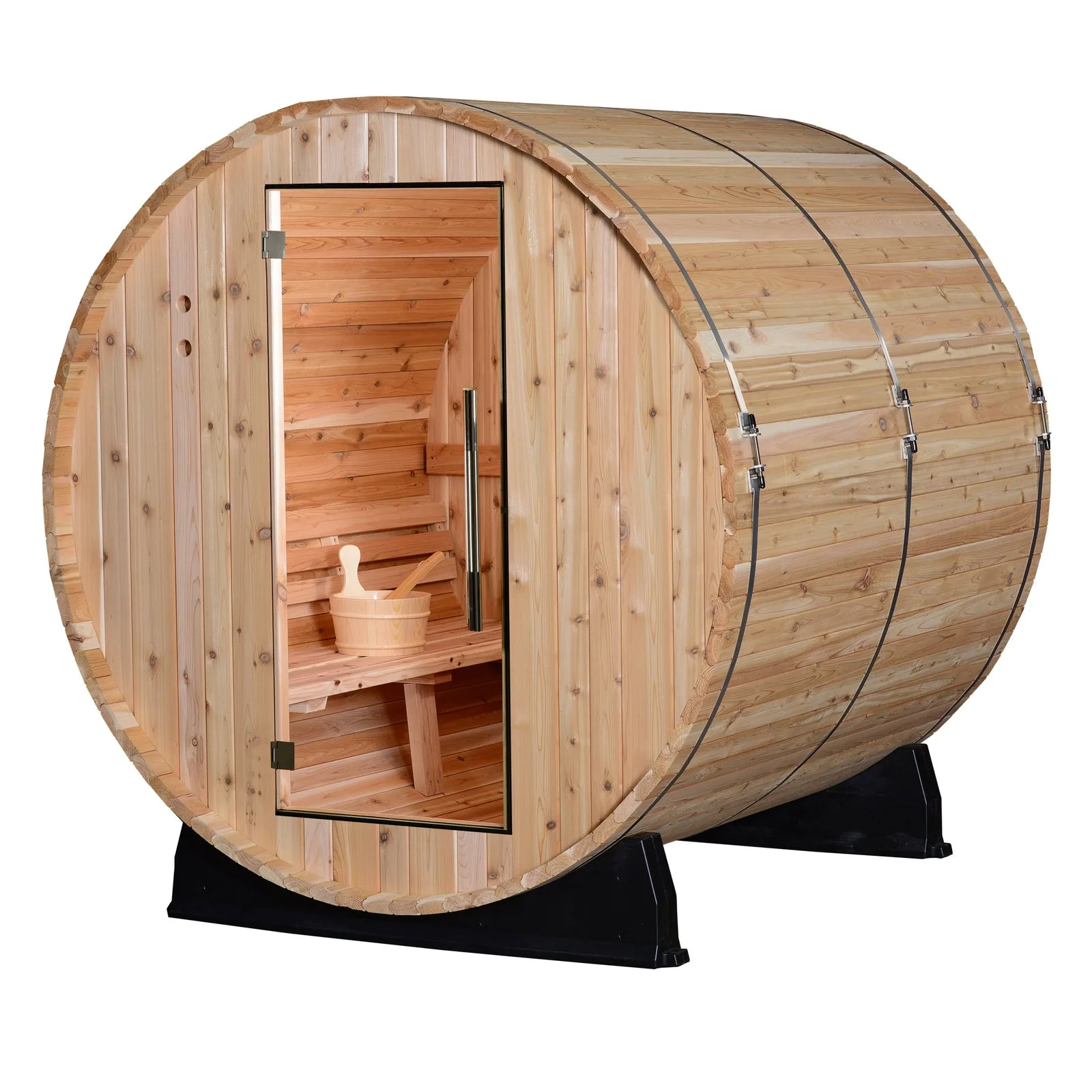
Almost Heaven
Pinnacle Barrel SaunaA backyard barrel sauna for people who want real Finnish heat and a reason to go outside in January.
Does the barrel shape really heat faster?
The pitch is geometry. A circle fills about 78.5% of the square drawn around it, so in theory a round cross-section holds roughly a fifth less air than a square room of the same width and height (that is our arithmetic; one dealer quotes 23%). Less air to heat, the argument goes, and curved walls that push rising heat back down toward the benches instead of letting it pool at the ceiling.
Two things complicate it. First, we found no controlled test that compares a barrel with a box at the same heater power, and a dealer review we read says the same. Second, a square cabin can take insulation in its walls, ceiling and floor; a barrel can't, because the staves are the wall. Owners in cold climates notice: one with a wood stove reached 85–90°C at −10°C outside but said the full-glass end panel 'leaks heat'.
- Headroom is the real trade-off. The curve takes space at the sides. Almost Heaven's 6-foot barrels have 69¼ inches inside at the peak; Redwood Outdoors' Extra-Wide 6-person lists 2 feet 11 inches of headroom above the bench.
- Bench depth varies. Almost Heaven's benches are 16 inches deep; Dundalk's Serenity MP lists 20 inches, which matters if you want to lie down.
- Glass costs heat. Panoramic and full-glass ends look great and lose heat fastest. Harvia's own manual tells you to add volume to your heater calculation for every square metre of glass.
Wood and stave thickness
With no insulation, the wood is the whole envelope. Thicker staves store a little more heat and are less prone to the warping that opens gaps the steel bands can't close. We found no lab data putting a number on that difference, so treat thickness as a durability signal more than a heat-up one. Builders and owners agree on one thing: cheap kits with thin staves are the ones that warp.
- Western red cedar (Almost Heaven, Dundalk): the heartwood is rated resistant to very resistant to decay, smells like a sauna should, and is the classic choice. Almost Heaven doesn't publish a grade, so expect some knots.
- Eastern white cedar (Dundalk Canadian Timber): lighter in colour and a little cheaper. We couldn't find a published stave thickness for this line.
- Thermally modified hemlock or spruce (Redwood Outdoors, SaunaLife, Thermory): wood baked at roughly 160–240°C in a controlled process, which makes it more dimensionally stable and more resistant to rot than the raw timber. It's darker, and it's the main reason Nordic brands use spruce outdoors.
- Avoid unnamed, chemically treated wood. Bargain marketplace barrels are the ones owners describe as off-gassing when hot and rusting at the hardware within a season.
Heater size and wiring
Owners' rule of thumb is about 1 kW per cubic metre of room, then round up for an uninsulated barrel. Harvia's manual is more specific: add 1.2 cubic metres of volume for every square metre of glass or other uninsulated surface. In practice the brands already pair heaters with rooms, and the pairings agree:
| Kit | Heater | Circuit |
|---|---|---|
| Almost Heaven 2- and 4-person (Salem, Pinnacle) | 6 kW | 240V, 30A, hardwired; light on a 120V/15A plug |
| Almost Heaven 6-person (Princeton) | 8 kW | 240V, 40A, hardwired |
| Redwood Outdoors barrels | 6 kW included; 8 kW and 9 kW options | 30A / 40A / 50A, licensed electrician |
| Dundalk Serenity and Tranquility | 7.5 kW recommended (not included) | Dedicated circuit; dealer says not on a GFCI breaker |
Two wiring questions come up in every owner forum. Breaker size: a 6 kW heater on 240V draws 25 amps, and the electrical code treats fixed heaters as continuous loads sized at 125%, which works out to 31.25 amps. Manufacturers list 30A anyway; some electricians go up a size. GFCI: vendors say it isn't universally required for sauna heaters, one dealer says the heater must not be on one, and some local inspectors require it outdoors. Your electrician and inspector decide both. One owner paid about $900 to have a heater wired; trenching to a far corner of the yard costs more.
Wood-burning barrels
A wood stove needs no circuit and heats hard in deep cold, but it brings a chimney, clearances to every wooden surface and a hearth. Almost Heaven offers a wood option on 7 of its 19 barrels, mostly the larger ones. Harvia's stove manual says not to share a flue, to sweep the chimney regularly and to check with local fire authorities. We found no national permit rule for backyard wood stoves, so call your building department and your home insurer before you order.
How long a barrel takes to heat
| Setup | Reported time | Source |
|---|---|---|
| Almost Heaven, any model | 165°F in 30–40 min; 185°F in under an hour | Manufacturer FAQ |
| Almost Heaven 4-person, 6 kW, 80°F outside | About 35 min to 180°F | Owner report |
| Same sauna, winter morning under 40°F | About 1 hour | Owner report |
| Almost Heaven 6-person, mild winter (40s °F) | 180°F at chest height in ~40 min; 200°F in ~1 hour | Owner report |
| Rented barrel at −20°C | 1–2 hours | Owner report |
| 4-person barrel, 8 kW | Struggled to reach 80°C at the bench; fell to ~65°C with two people | Owner report |
The spread is the point. In a mild climate a barrel is ready in about the time it takes to change and make tea. In a northern winter, plan on an hour, and use a heater with Wi-Fi or a timer so it's hot when you walk out. The few owners who never get the room hot usually point to heater placement, a thermostat sensor in the wrong spot, or too much glass.
The base, the permit and the build
- Level matters most. Almost Heaven says an uneven base makes the staves hard to align and stops the door latching. Its accepted bases are a concrete slab (3–4 inches), pavers, flagstone, a wood platform or 4–6 inches of compacted crushed stone. Not bare earth.
- It's heavy. Redwood Outdoors' 6-person barrel weighs 900 lb and its Extra-Wide 1,190 lb, before bathers. Redwood recommends a 4-inch slab with mesh, and an engineer's check if you're putting it on a deck.
- Permits depend on where you live. The model residential code exempts one-storey accessory structures up to 200 sq ft from a building permit, but many towns cut that to 120 sq ft or add their own rules. The electrical permit for the heater circuit is a separate question, and setbacks are set by local zoning.
- Assembly takes longer than the box says. Almost Heaven says 'a handful of hours' with two or three people; one self-described not-very-handy owner took 8–10 hours over two days. Almost Heaven's pro install starts at $1,400.
What goes wrong: leaks, bands and rot
- Rain between the staves. The most common complaint by far, including from owners of new kits in the Pacific Northwest. Almost Heaven's manual says driving rain may seep into the joints and won't harm the sauna, and the brand sells a rain cover. Owners also add roofing felt over the top third, a metal or polycarbonate roof, or a shed-style canopy.
- Bands need re-tightening. The wood shrinks and swells, especially in the first months. Almost Heaven says to check band tension every few months early on and that you may need to add filler staves. Owners suggest snug, not hard: one stripped a band by overdoing it.
- Doors that stop latching. Swollen doors after rain, or doors on an unlevel base, are a recurring thread.
- Rot at the bottom. Water pooling under the bottom staves is where rot starts, and Almost Heaven's lifetime warranty excludes rot. Drainage under the cradles matters more than the stain you choose.
- Finish the outside only. Stain the exterior with a UV-blocking product, never varnish or paint it, and never treat the interior.
What it costs to run
Electricity cost is kilowatts × hours × your rate. The figures below assume the heater runs flat out for the whole session, which is the worst case: once the room is up to temperature, the thermostat cycles the elements off and on. They use the US average residential rate of about 18.2¢ per kWh that the EIA forecasts for 2026. Use your own rate in the sauna running cost calculator.
| Session | 6 kW heater | 8 kW heater |
|---|---|---|
| 1 hour preheat + 30 min sauna | 9 kWh ≈ $1.64 | 12 kWh ≈ $2.18 |
| 2 hour winter preheat + 30 min | 15 kWh ≈ $2.73 | 20 kWh ≈ $3.64 |
| Three sessions a week, mild weather (a month) | ≈ $21 | ≈ $28 |
Spread the purchase over years of use and the per-session cost falls fast. Run that number in the cost-per-use calculator.
Barrel or cabin, outdoor or indoor?
- Pick a barrel if you want real Finnish heat and steam outdoors at the lowest price per seat, you have a level spot near power, and you don't mind some upkeep.
- Pick an insulated outdoor cabin if you live where winters are long and hard. It costs more but heats faster and holds temperature with the door opening.
- Pick an infrared cabin if it has to go indoors on a standard circuit and you prefer gentler heat. See infrared vs traditional sauna and our best home saunas.
When to buy: barrel prices drop hardest around Black Friday, when Almost Heaven runs about 30% off most models and Redwood Outdoors takes $500–$1,200 off larger orders. Shipping can take 6–12 weeks, so a November order is usually a January sauna. See when to buy a sauna. Once it's built, read how long to stay in a sauna and dry vs wet sauna.
Questions, answered
Are barrel saunas worth it?
For an outdoor traditional sauna on a budget, yes: a 4-person barrel with a heater costs about $5,000–$8,000 in fall 2026. Expect some upkeep (re-tightening bands, managing rain) and slower heat-up in deep cold because barrels have no insulation.
How long does a barrel sauna take to heat up?
Almost Heaven says 30–40 minutes to 165°F. Owners report about 35 minutes in warm weather, around an hour on cold mornings, and 1–2 hours in sub-zero conditions.
What size heater does a barrel sauna need?
Most 2- and 4-person barrels ship with a 6 kW heater on a 240V/30A hardwired circuit; 6-person barrels use about 8 kW on 40A. Size up if the sauna has a lot of glass or you live somewhere cold.
Do barrel saunas leak?
Many do in heavy or wind-driven rain, especially in the first months while the wood settles. Almost Heaven says minor seepage at the joints is normal. Re-tightening the bands and adding a cover or roof fixes most cases.
Do you need a permit for a barrel sauna?
Often not for the structure itself, since many towns exempt small accessory buildings, but the 240V heater circuit usually needs an electrical permit, and wood stoves may need a fire-safety sign-off. Check with your local building department.
Sources
- Almost Heaven: barrel saunas collection
- Almost Heaven: Pinnacle 4-person barrel sauna
- Almost Heaven: Salem 2-person barrel sauna
- Almost Heaven: Princeton 6-person barrel sauna
- Almost Heaven: FAQ (heaters, wiring, warranty, heat-up)
- Almost Heaven: barrel sauna instruction manual, 2024
- Almost Heaven: how to prepare your barrel sauna site
- Redwood Outdoors: 6-person barrel sauna
- Redwood Outdoors: Extra-Wide 6-person barrel sauna
- Redwood Outdoors: sauna assembly and foundations FAQ
- Leisurecraft (Dundalk): barrel saunas
- Sun Valley Saunas: Canadian Timber Serenity MP listing
- Select Fitness: SaunaLife E8 listing
- Sauna Marketplace: Thermory barrel sauna kit 50 Series
- Harvia wood-burning stove manual (volume and ventilation guidance)
- Hill, Altgen & Rautkari, thermal modification of wood: a review. Journal of Materials Science, 2021
- Virginia Tech dendrology: western red cedar wood properties
- Electrical Contractor: sizing conductors and continuous loads
- City of Federal Way: residential permit exemptions (IRC R105.2 example)
- EIA: Short-Term Energy Outlook, electricity prices
- r/Sauna: barrel owners with electric heaters, heat-up times
- r/Sauna: barrel saunas in cold climates
- r/Sauna: is this level of leaking normal for Almost Heaven?
- My Sauna World: assembling an Almost Heaven barrel sauna (owner account)
About the author
Ellis Ward · Founder & Editor
Ellis started Restalogy to find out which luxury rest and recovery gear actually earns its price, and has used a Herman Miller chair daily for years. Some products here Ellis has used first-hand; the rest are rated from specs, owner reports and the published research.